Szukaj na tym blogu

czwartek, 16 lutego 2017

Bitwa o przełęcz Reitzenhain/ Battle of Reitzenhain Pass- Black Powder 28.01.2017

Przedstawiam opis ostatniej, dużej bitwy, jaką rozegrałem 28 stycznia. Oczywiście sama bitwa jak i poprzedzające ją manewry i wydarzenia na innych odcinkach frontu są fikcyjne.

I present a description of the last, great battle that I played on January 28. Of course, the battle itself and preceding maneuvers and events on other sectors of the front are fictitious.


Po drugiej bitwie pod Waldenburgiem i przegrupowaniu wojsk armia napoleońska ponowiła ofensywę w kierunku południowym. Głównym jej celem było zniszczenie Armii Czeskiej księcia Szwarzenberga i wspierających ją korpusów pruskich i rosyjskich, co znacząco osłabiło by Koalicję i dało szansę na szybsze zakończenie wojny. Napoleon pomaszerował na Chemnitz, które uczynił swoim centrum operacyjnym, rozdzielając w ten sposób wojska sprzymierzonych- Austriacy cofnęli się na Drezno, a Rosjanie i Prusacy przekroczyli Rudawy i weszli do Czech. Dowiedziawszy się, że z powodu złego stanu dróg Austriacy wycofują się bardzo wolno i nie osiągnęli jeszcze Drezna, ani nawet Freibergu, Napoleon na czele większości swoich sił pomaszerował prosto na nich, chcąc zmusić przeciwnika do przyjęcia bitwy w niekorzystnych dla siebie warunkach. W celu obrony górskich przełęczy Napoleon wysłał VIII korpus księcia Poniatowskiego do Marienbergu, gdzie miał się umocnić i pilnować prawego skrzydła Wielkiej Armii przed atakiem Rosjan i Prusaków z terenu Czech.

After the Second Battle of Waldenburg and reforming troops, Napoleonic army renewed its offensive to the south. The main objective was to destroy the Army of the Bohemia commanded by prince Szwarzenberg and Prussian and Russian corps supporting it, which would significantly weakened the Coalition and gave the opportunity for ending the war soon. Napoleon marched to Chemnitz, which was made his operations center, thereby separating the Alied forces- Austrians fell back to Dresden, and the Russians and Prussians crossed the Ore Mountains and went to Bohemia. Learning that due to the poor condition of roads Austrians are retreating very slowly and have not yet reached Dresden, or even Freiberg, Napoleon led the majority of his forces straight at them, trying to force the enemy to accept battle on unfavorable conditions. In order to defend the mountain passes, Napoleon sent 8th corps of Prince Poniatowski to Marienberg, where he had to fortify and keep an eye on the right flank of the Grand Army and protect it from the attack of the Russians and Prussians from Bohemia.


 Sprzymierzeni tymczasem planowali zmniejszyć nacisk na wojska austriackie właśnie poprzez taki atak. Gdyby udało im się przekroczyć Rudawy i ponownie wkroczyć do Saksonii, Napoleon musiałby się wycofać na północ, by uniknąć oskrzydlania, a armia austriacka była by uratowana.

Allies meanwhile, planned to reduce the pressure on the Austrian army precisely through such an attack. If they managed to cross the Ore Mountains and re-enter to Saxony, Napoleon would have to withdraw to the north to avoid flanking, and the Austrian army would be rescued.


Skoncentrowawszy większość sił w Komotau, Rosjanie i Prusacy ruszyli starym szlakiem na północ, na Marienberg, by wyjść prosto na prawe skrzydło Francuzów. Teren był trudny, przez góry biegła tylko jedna droga, a strome zbocza po obu jej stronach porośnięte były gęstym lasem. Na domiar złego drogę, niczym korek butelkę, blokowali Polacy...

Concentrating most of the forces in Komotau, Russians and Prussians moved by the old trail to the north, heading for Marienberg, to come out straight on the right flank of the French. The terrain was difficult, only one way ran through the mountains, and steep slopes on both sides were covered with dense forest. On top of that the way was blocked by the Poles like a cork closes the bottle...


Poniatowski, mając kilkukrotnie mniej wojska, niż przeciwnicy, zdecydował się powstrzymać atak na samych przełęczach, co niwelowało przewagę liczebną wroga. Jego siły obsadzały dwie przełęcze: Reitzenhain i Preßnitzer, z rezerwą generalną w Marienbergu. Oba szlaki zostały zablokowane zasiekami i umocnione redutami, by jeszcze bardziej utrudnić zadanie atakującym.

Poniatowski, having several times less troops than the opponents, decided to stop the attack on the passes, which would compensate the greater number of enemy troops. His forces were occupied two passes: Reitzenhain and Preßnitzer, with the general reserve in Marienberg. Both routes were blocked with barricades and fortified redoubts, to further complicate the task to the attackers.

Polskie pozycje/ Polish positions

Główne siły sprzymierzonych kierowały się na przełęcz Reitzenhain. Dwa biegnące z południa trakty łączyły się przed przełęczą, którą blokowała barykada obsadzana przez wydzieloną kompanię grenadierów 7 Pułku Piechoty. W lasach po bokach czaili się woltyżerowie, a na pikiecie z przodu stała grupa huzarów z  13 pułku. Była to straż przednia wojsk polskich, mająca opóźnić marsz Sprzymierzonych.

The main allied forces were heading to the Reitzenhain pass. Two routes running from the south merges before the pass, which was blocked by the barricade manned by a separate grenadier company of 7th Regiment of Infantry. In the forests on the sides the voltigeurs lurked, and on the picket line in front stood small unit of 13 Hussars regiment. It was the vanguard of the Polish army, having to delay the march of the Allies.

Prusacy/ Prussians

Rosjanie/ Russians
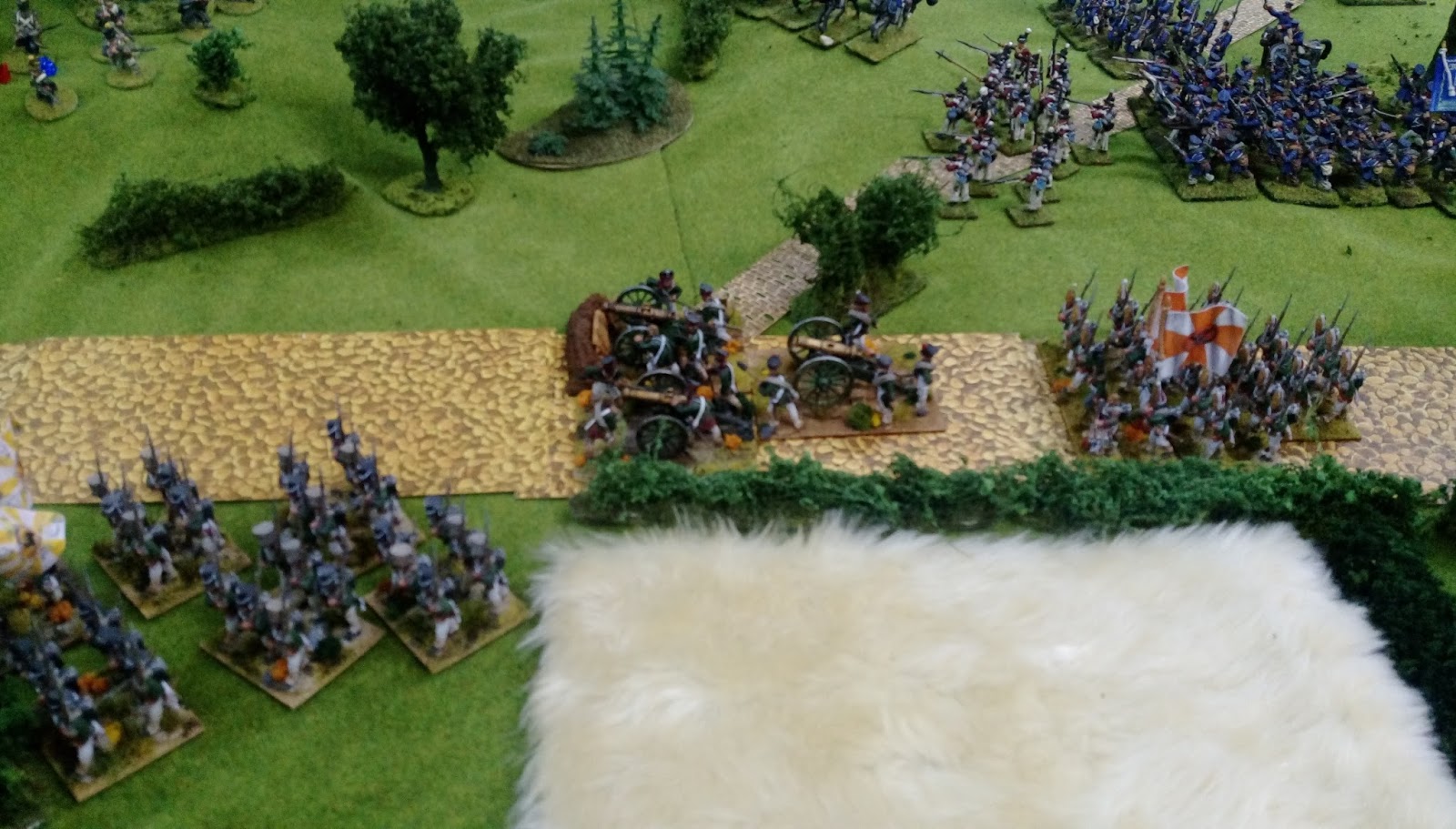
Pierwszy kontakt nastąpił koło południa. Nadciągające z południa wojska pruskie i rosyjskie szybko zepchnęły polskie pikiety i celnym ogniem artylerii przepędziły grenadierów. Rozpoznawszy teren i położenie wojsk polskich, generałowie von Kleist i Paskiewicz uznali, że natarcie wzdłuż drogi wiązało by się ze zbyt dużymi stratami, gdyż kolejne oddziały mogłyby być rozbijane przez Polaków pojedynczo i nie można by wykorzystać ogromnej przewagi liczebnej nad wojskami Poniatowskiego. Zdecydowano więc, że na drodze rozstawi się rosyjska artyleria, za nią, w rezerwie, zostanie cała kawaleria, a piechota pójdzie lasami- Prusacy od wschodu, Rosjanie od zachodu.

Dowódcy Sprzymierzonych/ Allied commanders


The first contact took place around noon. Approaching from the south Prussian and Russian armies quickly pushed Polish pickets and accurate artillery fire drove out the grenadiers. After recognizing the terrain and the position of the Polish army, the generals von Kleist and Paskevich decided that the attack along a road was associated with great losses, because their units would be broken one by one by the Poles and the vast numerical superiority over the Poniatowski troops could not be used. It was therefore decided that the track will be occupied by the Russian artillery with cavalry behind, in reserve, and the infantry would go through the woods- Prussians east, Russians west.


Polscy woltyżerowie dzielnie opóźniali marsz Sprzymierzonych, lecz musieli wkrótce ulec ich przewadze. Większą trudność dla Prusaków i Rosjan stanowił jednak trudny teren- strome, porośnięte gęstym lasem zbocza bardzo skutecznie opóźniały marsz wrogiej piechoty, zapewniając Polakom cenny czas. Przez następne godziny jedynie rosyjska artyleria dawała o sobie znać ciągłym, lecz niezbyt celnym ogniem.


Polish voltigeurs valiantly delayed the march of the Allied infantry, but they were quickly forced to retreat.  Greater difficulty for the Prussians and Russians, however, was a rough ground- steep slopes covered with dense forest very effectively delayed the march of the enemy infantry, providing Poles valuable time. For the next few hours only Russian artillery fired with continuous, but not very accurate fire.


Słońce chyliło się powoli ku zachodowi, gdy z lasu wyłoniły się pierwsze oddziały korpusu von Kleista. Kilka kompanii brytyjskich marines podeszło w tyralierze do pozycji 6. Pułku Piechoty, lecz powitani morderczą salwą rzucili się do ucieczki. Tuż za nimi pojawiły się 3 bataliony landwery oraz muszkieterowie i fizylierzy 1. Zachodniopruskiego Pułku Piechoty von Klüxa. Prusacy uderzyli na bagnety, lecz 6. Pułk morderczymi salwami z bliska i niezłomną postawą odparł wszystkie szarże.


The sun was slowly going down when from the forest emerged first units of von Kleist's corps. Several companies of British marines approached in the skirmish order to the position of 6th Infantry Regiment, but they were welcomed by the murderous volley and they fled. Just behind them, there were 3 battalions of Landwehr as well as musketeers and fusiliers of von Klüx's 1st Westprussian Infantry Regiment. The Prussians attacked with the bayonets, but the 6th Regiment with deadly volleys from close range and steadfast attitude repell all the charges.


6. Pułk Piechoty oczekuje wroga/ 6th Infantry Regiments awaits enemy

Utrzymać pozycję za wszelką cenę!/ Hold at all cost!

Ze wsparciem na lewe skrzydło wojsk polskich przybył 5. Pułk Strzelców Konnych, jednak dostał się pod morderczy ogień pruskich fizylierów i został zmuszony do odwrotu. Mimo to kawalerzyści wycofali się w porządku i stanęli w szyku kilkaset metrów dalej.

5th Regiment Chasseurs a Cheval arrived to the left flank of Polish forces with support, but it came under deadly fire of the Prussian Fusiliers and was forced to retreat. Cavalry retreated fine though, and they stood in formation a few hundred meters away.


W międzyczasie pruska artyleria przekroczyła przełęcz, by wesprzeć swoją piechotę, a oddział konnej landwery popędził drogą, chcąc przebić się przez polskie pozycje. Kawalerzyści dostali się jednak pod flankowy ogień 1. Pułku Piechoty i cofnęli się w nieładzie.


In the meantime, the Prussian artillery crossed the pass to support the infantry and mounted Landwehr rushed through the road, trying to break through the Polish positions. Riders got, however, the flank fire from 1st Infantry Regiment and fell back in disarray.


Na zachód od drogi tymczasem pojawiły się oddziały rosyjskie. Polska artyleria natychmiast wzięła je na cel, a Legia nadwiślańska wraz z 15. Pułkiem Ułanów zaatakowała najbliższy batalion. Rosjanie sformowali czworobok i odparli szarżę kawalerii, która uciekła z pola bitwy, natomiast Legia Nadwiślańska została zdezorganizowana ogniem drugiego rosyjskiego batalionu i nie zdołała wykorzystać sytuacji, by uderzyć na bagnety. Po chwili Rosjanie ustawili się w linii i zasypali Polaków gradem kul, dziesiątkując ich szeregi i zmuszając do odwrotu. Tylko 3. Pułk Piechoty oraz schowana w reducie artyleria pozostały do obrony prawego skrzydła.


West of the road, the Russian troops appeared. Polish artillery immediately took aim on them, and Vistula Legion with the 15th Uhlan Regiment attacked the nearest battalion. Russians formed square and repelled the cavalry charge, which had fled from the battlefield, while Vistula Legion was disorganized by the fire of second Russian battalion and failed to take advantage of the situation and hit with bayonets. After a while the Russians formed a line and covered Poles with a hail of bullets, decimating their ranks and forcing them to retreat. Only 3rd Infantry Regiment and artillery hidden in a redoubt remained to defend the right flank.


Na lewym skrzydle Polaków sytuacja też zaczęła się pogarszać. 6. Pułk Piechoty, wyczerpany i zdziesiątkowany od nieustannej walki na najbliższy dystans, został w końcu wyparty ze swojej pozycji i rzucił się do ucieczki. 1. Pułk Piechoty jeszcze się trzymał, lecz był w niewiele lepszym stanie i musiał wkrótce ulec. Chociaż pruskie brygady zostały rozbite i nie paliły się do kolejnych natarć, artyleria Sprzymierzonych wciąż siała zniszczenie, a potężna rezerwa kawalerii stanowiła realne zagrożenie dla osłabionej polskiej piechoty.


On the Polish left flank the situation also get worse. 6th Infantry Regiment, exhausted and decimated by the constant fight for the nearest distance, was finally forced out of his position and fled. 1st Regiment still held, but it was only in a little better condition and had to be defeated soon. Although the Prussian brigades were broken and unable to carry out subsequent assaults, Alied artillery still sowed destruction, and a huge reserve of cavalry was a real threat to the weakened Polish infantry.


Odwrót!/Retreat!

Słońce już dawno zaszło nad polem bitwy i Poniatowski wiedział, że wypełnił swoje zadanie. Nakazał więc generalny odwrót na Marienberg, gdzie miał nadzieję uzyskać informacje o wyniku rozprawy między Napoleonem i Shwarzenbergiem. Sprzymierzeni zajęli przełęcz, lecz ponieśli przy tym duże straty (zwłaszcza Prusacy) i osiągnęli swój cel zbyt późno, by mieć nadzieję na zmianę położenia armii austriackiej. Plan wyjścia na tyły armii francuskiej się nie powiódł. Wszystko zależało teraz od tego, czy Austriakom udało się wymknąć, czy też Napoleon zadał im druzgocącą klęskę, co zmusiłoby Sprzymierzonych do przystąpienia do rozmów pokojowych na warunkach podyktowanych przez Cesarza Francuzów...

The sun had long gone over the battlefield and Poniatowski knew that he fulfilled his task. Therefore he ordered the general retreat to the Marienberg, where he hoped to get information about the outcome of the fight between Napoleon and Shwarzenberg. Allies took the pass, but suffered heavy losses (especially Prussian) and achieved their goal too late to hope for a change the position of the Austrian army. The plan of entering to the rear of the French army failed. Everything now depended on whether the Austrians were able to escape, or Napoleon dealt with them with a crushing defeat, which would force the Allies to join peace talks under the conditions dictated by the Emperor of the French...


***

W tej bitwie dowódcy Sprzymierzonych mieli bardzo trudne zadanie. Pomimo dużej przewagi liczebnej (ponad 2:1 w piechocie i kawalerii, 5:1 w artylerii), ukształtowanie terenu i warunki zwycięstwa działały na korzyść Polaków. Moim zdaniem też błędem było posłanie całej piechoty lasami i praktycznie nie wykorzystanie drogi przez przełęcz. Rozumiem powody, jakimi kierowali się dowódcy Sprzymierzonych, lecz mając stosunkowo niewiele czasu na wypełnienie zadania (8 tur), należało zaryzykować. Tak czy inaczej, gdy w końcu doszło do walki, była ona krwawa i ciekawa, chociaż niezbyt długa ;) Rozegraliśmy o jedną turę więcej, niż zakładał wymyślony przeze mnie scenariusz i to w pełni pokazało, że Polacy nie byli w stanie długo wytrzymać naporu liczniejszej piechoty wroga, pomimo zadania im znacznych strat (rozbicie dwóch pruskich brygad i tym samym praktyczne wyeliminowanie Prusaków z walki, kosztem jednak poważnego osłabienia własnych sił, które nie były by w stanie długo powstrzymywać świeżej, rosyjskiej piechoty).

In this battle, the commanders of the Allied forces had a very difficult task. Despite the large numerical superiority (over 2: 1 in the infantry and cavalry, 5: 1 in artillery), terrain and victory conditions worked in favor of the Poles. In my opinion, it was a mistake to send the entire infantry through the woods and not to use the road through the pass. I understand the reasons which guided the Allied commanders, but having relatively little time to complete the task (8 rounds), they should take a risk. Anyway, when it finally came to fight, it was bloody and interesting, although not very long;) We played one round more than assumed in the scenario and it has fully demonstrated that the Poles were not able to withstand the pressure of more numerous enemy infantry for too long, despite the significant losses inflicted to them (breaking two Prussian brigades and thus virtually eliminate the Prussians out of the fight, but at the cost of a serious weakening of own forces, which would not be able to hold back for a long time the fresh, Russian infantry).

Bohaterowie dnia- 6. Pułk Piechoty/ Heroes of the day- 6th Infantry Regiment
Mam nadzieję, że niebawem uda się znowu rozegrać jakąś bitwę, chociaż wolałbym wypróbować inny system, niż Black Powder, który jest łatwy i przyjemny, ale mało realistyczny. W klubie zaczęliśmy tworzyć własne przepisy do wojen napoleońskich na niskim szczeblu (pułk/brygada), ale nie pogardziłbym też np. rozgrywką w General de Brigade. Zobaczymy, co z tego wyjdzie ;) 

I hope that soon I will be able to play again, but I would rather try a different system than the Black Powder, which is easy and enjoyable, but hardly realistic. In the club, we began to create our own rules for the Napoleonic wars at a low level (regiment / brigade), but I do not mind to try, for example, the General de Brigade rules. We'll see what comes out ;)


poniedziałek, 6 lutego 2017

Druga bitwa pod Waldenburgiem/ 2nd battle of Waldenburg 6.01.2017

Kilka tygodni temu rozegrałem kolejną bitwę w Black Powder. Jako że był jeszcze rozstawiony teren po poprzednim starciu, była to druga bitwa pod Waldenbergiem ;) Zarówno sama bitwa, jak i opis poprzedzających ją manewrów są fikcyjne.

A few weeks ago I played another battle with Black Powder rules. As the terrain from previous battle was still set, this clash was the second battle of Waldenberg;) The battle itself, as well as a description of the preceding maneuvers, are fictitious.

Prusacy/ Prussians
Po pokonaniu Rosjan VIII Korpus pomaszerował na Chemnitz, gdzie miał połączyć się z innymi oddziałami Wielkiej Armii i prowadzić działania przeciwko Armii Czeskiej księcia Shwarzenberga, jednak manewry sprzymierzonych doprowadziły do zaniechania tego planu i zmusiły wojska napoleońskie do odwrotu.Książę Poniatowski, powiadomiony o obecności wojsk pruskich w Altenburgu, spieszył na północny- zachód, przez Waldenberg, by osłonić cofające się prawe skrzydło wojsk francuskich. Niestety, Prusacy forsownymi marszami dotarli do miasteczka w tym samym momencie, co Polacy. Bitwa była więc nieunikniona.

After defeating of the Russians 8th Corps marched to Chemnitz, where he had to join forces with other units of the Grand Army and carry out actions against the prince Shwarzenberg's Army of Bohemia, but allied maneuvers led to the abandonment of this plan and forced Napoleon's forces to retreat. Prince Poniatowski, informed about the presence of Prussian troops in Altenburg, marched quickly north west, by Waldenberg to protect the right wing of the retreating French army. Unfortunately, the Prussians reached the town at the same time as the Poles.Tthe battle was inevitable.

Straż przednia VIII Korpusu księcia Poniatowskiego/ Prince Poniatowski's 8th Corps vanguard
Poniatowski, dysponując mniejszymi siłami, zdecydował się jak najszybciej zająć miasto i bronić się w nim do nadejścia posiłków. 1 Pułk Piechoty ruszył więc biegiem i sformował się w linię na głównej ulicy miasta, oczekując nadejścia kolumn pruskiej landwery. Woltyżerowie Białkowskiego, 3. Pułk Piechoty i Legia Nadwiślańska podążyły za nim, a kawaleria sformowała się na polu, osłaniając południową flankę.

Poniatowski, knowing that his forces are weaker, decided to take the city as soon as possible and defend it until the reinforcements arrive. 1st Infantry Regiment ran and formed a line in the main street of the city, awaiting the arrival of columns of Prussian Landwehr. Białkowski's voltigeurs, 3rd InfantryRegiment and Vistula Legion followed and the cavalry formed in the field, covering the southern flank.


1. Pułk Piechoty/ 1st Infantry Regiment
Pruska landwera majora von Beckendorffa ruszyła żwawo naprzód, podczas gdy piechota liniowa von Klüxa i artyleria ostrożnie posuwały się na południe od traktu do Oberwiera. Landwera weszła między zabudowania w kolumnach marszowych, gdzie od razu dostała się pod silny ogień 1. Pułku Piechoty, ponosząc dotkliwe straty. Ułani z 15. Pułku z kolei, widząc, że pruska artyleria wysforowała się do przodu, zostawiając z tyłu piechotę i osłaniającą ją jazdę, przekroczyli rzekę w bród i rozproszyli artylerzystów. Kawalerzyści zajęci byli jeszcze gonieniem niedobitków i ponownym formowaniem się, gdy wpadł na nich z nastawionymi bagnetami batalion muszkieterów 1. Zachodniopruskiego Pułku Piechoty von Klüxa. Zaskoczeni ułani poszli w rozsypkę i porzucili zdobyte chwilę wcześniej armaty.


Prussian landwehr of Major von Beckendorff walked hastily forward, while von Klux's line infantry and artillery were moving cautiously south of the route to Oberwiera. Landwehr came between the buildings in the marching columns , where he immediately came under heavy fire of 1st Infantry Regiment and suffered heavy losses. Meanwhile lancers from the 15th Regiment, seeing that Prussian artillery moved fast to the front, leaving the infantry and protecting cavalry behind, crossed the river at the ford and scattered the gunners. Uhlans were still busy chasing the survivors and re-formation when Musketeers battalion of von Klux's 1st Westprussian Infantry Regiment rushed at them with fixed bayonets. Surprised Lancers went into disarray and abandoned captured cannons.


Sytuacja w samym mieście tymczasem niewiele się zmieniła- na lewym skrzydle 1. Pułku Piechoty, przy moście, stanęła w linii Legia Nadwiślańska, a po prawej, za miastem- 3. Pułk Piechoty. Woltyżerowie obsadzili zabudowania przy południowym krańcu mostu, a artyleria, pod osłoną 5. Pułku Strzelców Konnych, rozstawiła się na drodze do Callenbergu.

In the meantime he situation in the city little changed- on the left flank of 1st Infantry Regiment, at the bridge, Vistula Legion stood in line, and on the right, behind the city- 3rd Infantry Regiment. Voltigeurs occupied the buildings at the southern end of the bridge, and artillery, under the cover of the 5th Regiment of Chasseurs a Cheval, unlimbered on the road to Callenberg.


Jeden z batalionów landwery zdołał się w międzyczasie sformować w linię i osłonić pozostałe oddziały, które porządkowały szeregi i formowały kolumny. W miasteczku trwała zażarta wymiana ognia i chociaż Polacy byli w niej górą, zaczęli ponosić straty. 3. Pułk Piechoty, w panującym zamieszaniu, źle zrozumiał rozkaz nakazujący mu rozwinąć się na prawym skrzydle 1. Pułku i zamiast tego poszedł w lewo, przekraczając strumień. Sytuacja zaczęła być niebezpieczna, bo prawej flance 1. Pułku zaczął zagrażać jeden z batalionów landwery, na szczęście nie palił się do szturmu, tylko ostrzeliwał Polaków spomiędzy zabudowań.

One of the landwehr battalions managed to form line and protect the remaining troops, which reorganized ranks and formed columns. The fierce exchange of fire continued in the town, and although the Poles had the upper hand, they began to suffer losses. 3rd Infantry Regiment, in the prevailing confusion, misunderstood an order instructing him to form on the right flank of 1st Regiment and instead went to the left, crossing a stream. The situation began to be dangerous, because the right flank of 1st Regiment was threaten by one of the Landwehr battalions, but fortunately it wasn't eager to the assault and only fired to the Poles from between buildings.


Prusacy przejęli inicjatywę i zaczęli naciskać wojska Poniatowskiego na wszystkich odcinkach. Batalion fizylierów, wspierany przez szwadron konnej landwery, przekroczył w bród rzekę, by zagrozić lewemu skrzydłu wojsk polskich. Dostawszy się pod ogień polskich woltyżerów kryjących się w zabudowaniach, pruscy kawalerzyści rzucili się do ucieczki, jednak fizylierzy celnym ogniem uciszyli artylerię, która wycofała się z pola walki osłaniana przez 5. Pułk Strzelców Konnych.

The Prussians took the initiative and began to push the Poniatowski's forces everywhere. Fusilier battalion, supported by a squadron of horse landwehr, crossed the river to threaten to the left flank of Poles. They got the fire from Polish skirmishers hiding in buildings, Prussian cavalry fled, but fusiliers accurate fire silenced the artillery, which withdrew from the battlefield shielded by the 5th Regiment of Chasseurs a Cheval.


Wśród zabudowań Waldenburga trwała zażarta walka. Prusacy sformowali kolumny i udeżyli na 1. Pułk Piechoty, który krwawo odparł pierwszy szturm. Oddziały von Klüxa nacierały tymczasem wzdłuż rzeki, lecz Legia Nadwiślańska dała im zdecydowany odpór i zmusiła do ucieczki, po czym przesunęła się na prawe skrzydło, by wzmocnić obronę na tamtym odcinku. Miejsce Legii na moście zajął 3. Pułk Piechoty. Pruska landwera ponownie natarła na 1. Pułk i tym razem zdecydowana przewaga liczebna Prusaków oraz zmęczenie Polaków przyniosły efekt- polska piechota rzuciła się do ucieczki.

Among the buildings of Waldenburg the fierce struggle continued. Prussians formed a column and charged the 1st Infantry Regiment, which bloodily repulsed the first assault. Von Klux's units attacked meanwhile along the river, but Vistula Legion hold their ground and forced attackers to flee. Then Poles moved to the right flank to reinforce the defense on that sector. 3rd Infantry Regiment took place of the Vistula Legion at the bridge. Prussian landwehr again assaulted on the 1st Regiment, and this time the overwhelming numerical superiority of the Prussians, and fatigue of the Poles brought efect- Polish infantry escaped from the field.


W tym momencie musieliśmy, niestety, skończyć bitwę. Zgodnie z ustaleniami Polacy wypełnili cel- na koniec bitwy kontrolowali most, jednak nie utrzymali by się o wiele dłużej- przewaga liczebna wroga coraz bardziej dawała o sobie znać. Na szczęście na horyzoncie widać już było kolejne oddziały VIII korpusu, które wzmocniły przerwaną linię i odepchnęły Prusaków, zabezpieczając przeprawę dla reszty wojska.

At this point we had, unfortunately, to end the battle. According to the scenario objectives, the Poles have won by controlling the bridge at the end of the battle, but they wouldn't hold much longer- numerical superiority of the enemy was too high. Fortunately, on the horizon the new units of 8th Corps appeared, which fueled a broken line and pushed back the Prussians, securing crossing for the rest of the army.